


Postgraduate Students Conference 2026
PG Students Conference 2026 - Cultivating Research Excellence: A Postgraduate Conference Across Disciplines
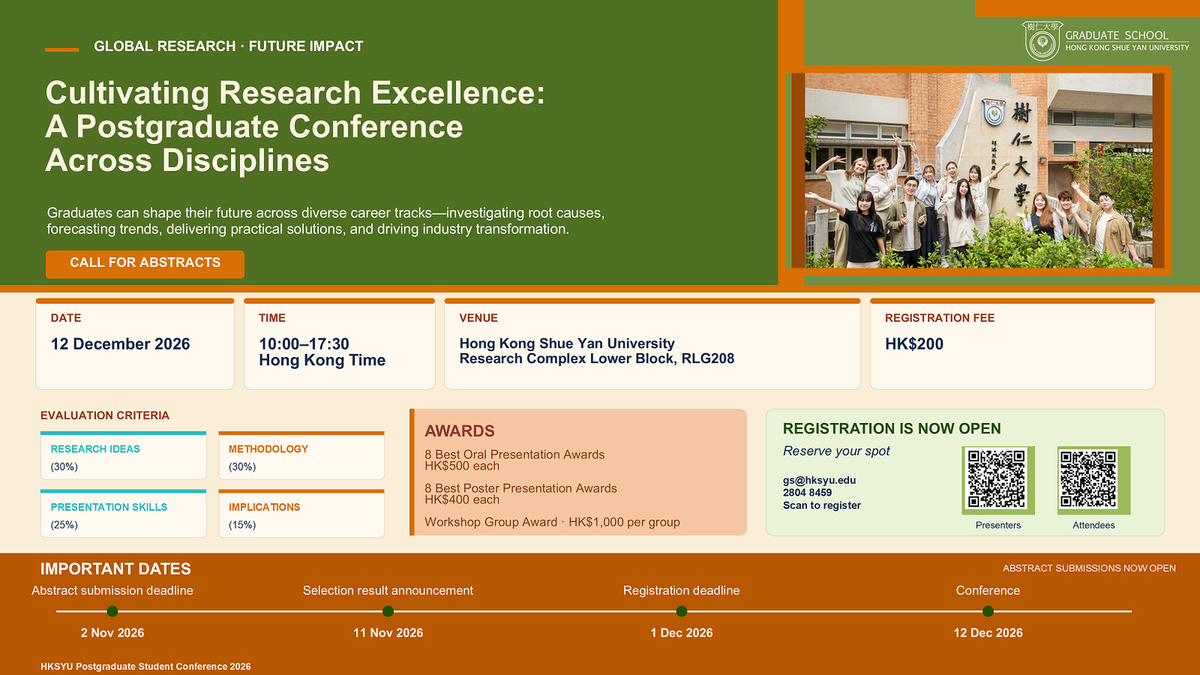
The Graduate School of Hong Kong Shue Yan University warmly invites all postgraduate students to participate in the HKSYU Graduate Student Conference. The conference provides a valuable platform for students to showcase their research, exchange ideas across academic disciplines, and engage with fellow researchers and members of the academic community. It aims to strengthen students’ research and presentation skills, advance an interdisciplinary research culture, and support their career and professional development. Whether you wish to present your work or attend as a participant, we encourage you to join us in celebrating student research, fostering meaningful academic exchange, and building connections within our postgraduate community.
Conference Details and Eligibility
Date: 12 December 2026
Time: 10:00a.m. – 5:30p.m. (GMT+8)
Venue: RLG208, Hong Kong Shue Yan University Research Complex, Lower Block
LCC01-LCC06, Hong Kong Shue Yan University, Library Complex
LCC01-LCC06, Hong Kong Shue Yan University, Library Complex
Language: English
Target eligibility for Abstract Submission: Current postgraduate students at Hong Kong Shue Yan University and other higher education institutions, as well as postgraduate alumni who graduated within the past 18 months, are eligible to submit abstracts.
Target participants: The symposium welcomes anyone who is passionate about the topics presented and interested in exchanging ideas and experiences.
Explore Our Speakers
Keynote Speakers: tbc
Roundtable Speakers:
1) Prof. Siqi HAN

Siqi Han is an assistant professor of sociology at the Chinese University of Hong Kong (CUHK), where she is also involved with the computational social science cluster. Before joining CUHK, she was a postdoctoral researcher at Columbia University. She completed her PhD at the Ohio State University. Her research focuses on the structure of knowledge within college curricula, the interplay between field of study and school-to-work transitions, and the economic returns of skills in the labor market. Utilizing a mix of surveys and unstructured textual data, Siqi employs advanced quantitative methods, particularly machine learning and LLM-based data collection, to tackle fundamental questions regarding social stratification. She finds joy in defining complex concepts and measuring them with quantitative rigor. Recent updates to her work include exploring skill diversity at the job level, economic returns to curriculum interdisciplinarity, deservingness described in college crowdfunding campaigns, and national gender egalitarian progress in relation to women’s overeducation. These papers appeared in American Journal of Sociology, PNAS, European Sociological Review, Journal of Marriage and Family, Social Science Research, Research in Social Stratification and Mobility, among others.
2) Prof. JO Duckhyun
1) Prof. Siqi HAN
Siqi Han is an assistant professor of sociology at the Chinese University of Hong Kong (CUHK), where she is also involved with the computational social science cluster. Before joining CUHK, she was a postdoctoral researcher at Columbia University. She completed her PhD at the Ohio State University. Her research focuses on the structure of knowledge within college curricula, the interplay between field of study and school-to-work transitions, and the economic returns of skills in the labor market. Utilizing a mix of surveys and unstructured textual data, Siqi employs advanced quantitative methods, particularly machine learning and LLM-based data collection, to tackle fundamental questions regarding social stratification. She finds joy in defining complex concepts and measuring them with quantitative rigor. Recent updates to her work include exploring skill diversity at the job level, economic returns to curriculum interdisciplinarity, deservingness described in college crowdfunding campaigns, and national gender egalitarian progress in relation to women’s overeducation. These papers appeared in American Journal of Sociology, PNAS, European Sociological Review, Journal of Marriage and Family, Social Science Research, Research in Social Stratification and Mobility, among others.
2) Prof. JO Duckhyun

Dr. Duckhyun Jo is an Assistant Professor in the Department of Social and Behavioural Sciences at City University of Hong Kong. He received his Ph.D. in Clinical Psychology from the University of Hawaiʻi at Mānoa. His research focuses on the mechanisms of change underlying cognitive-behavioral interventions, particularly Acceptance and Commitment Therapy (ACT), and the role of modifiable transdiagnostic processes in psychopathology and health behavior problems across diverse populations. His work employs a range of advanced methodologies, including network analysis, item response theory, Bayesian statistics, machine learning, and large language models, to improve the understanding, assessment, and delivery of psychological interventions.
3) tbc
4) tbc
Abstract Submission Guidelines
1.Choose a Track
Every submission must fit one of the four conference tracks
|
Track
|
Focus
|
|
A: Explanatory
|
Uncovering why things are the way they are (root-cause studies, theory-building and theory-testing, comparative or historical explanation)
|
|
B: Applied Insights and Solutions
|
Forecasting the future or creating a solution to a problem (prediction, interventions, policy or practice recommendations)
|
|
C: Evaluating Impact
|
Understanding the impact of a known phenomenon (programme and policy evaluation, outcome assessment, before-after or longitudinal comparison)
|
|
D: Integration with Innovative Technology
|
How innovative technology can be applied to your field (AI, digital tools, technology adoption, ethical considerations)
|
2.Choose a Presentation Format
|
|
Oral Presentation
|
Poster Presentation
|
Seminar
|
|
Format
|
20 minutes per presenter
|
Poster display and discussion
|
Themed session combining 3 to 4 presentations (within 1.5 hours)
|
|
Abstract length
|
Up to 250 words
|
Up to 250 words
|
Up to 500 words per seminar
|
|
Expected work
|
Full research with complete methods, results and conclusions
|
Preliminary data or research proposals
|
Research on a shared theme across the 3 to 4 presentations
|
|
Awards
|
Yes (12 awards)
|
Yes (12 awards)
|
No
|
3.Writing Your Abstract (250 words maximum)
Write in English as a single paragraph or with brief labelled sections. The word limit excludes the title, author details and keywords.
Oral presentations (full research) should cover:
Background and research gap
Objectives or research questions
Methods (design, sample, analysis)
Key findings
Conclusions and implications
Poster presentations (preliminary data or proposals) should cover:
Background and research gap
Objectives or research questions
Planned or current methods
Preliminary findings or expected outcomes
Anticipated contribution
Please include: title, author(s) and affiliation(s), supervisor name, chosen track, chosen format, 3 to 5 keywords, and the corresponding author's email.
Please avoid: work that is unrelated to the tracks, abstracts over the word limit, and material already published in full. Submissions proposed as oral presentations that do not yet have full results may be offered a poster slot instead.
**Abstracts are reviewed by the organising committee for track fit, clarity, and whether the stage of research suits the chosen format.
**Abstracts are reviewed by the organising committee for track fit, clarity, and whether the stage of research suits the chosen format.
Abstract Submission
Abstract Submission: (tbc)
Submission Deadline: 2 November 2026, 11:59 p.m. (GMT+8)
**The Microsoft CMT service was used for managing the peer-reviewing process for this conference. This service was provided for free by Microsoft and they bore all expenses, including costs for Azure cloud services as well as for software development and support.
Submission Deadline: 2 November 2026, 11:59 p.m. (GMT+8)
**The Microsoft CMT service was used for managing the peer-reviewing process for this conference. This service was provided for free by Microsoft and they bore all expenses, including costs for Azure cloud services as well as for software development and support.
Selection Criteria and Awards
Assessment and selection criteria:
a) Research Ideas (30%)
b) Methodology (30%)
c) Presentation Skills (25%)
d) Implications (15%)
Awards:
Awards:
Eight Best Oral Presentation Awards: HKD 500 each
Eight Best Poster Presentation Awards: HKD 400 each
Workshop Awards: HKD 1,000 per group
Programme Schedule
|
Time
|
Programme
|
|
10:00 – 10:20
|
Opening Speech — Prof. Hue, Vice-President (Graduate School)
|
|
10:20 – 11:20
|
Keynote 1: How Good Research Informs Society
|
|
11:20 – 12:20
|
Roundtable 1: Career Pathways After Graduation (Young scholars share career journeys and advice for making the most of postgraduate study)
|
|
12:30 – 13:30
|
Lunch Break
|
|
13:30 – 15:00
|
Parallel Session 1
|
|
LC C01, LC C02
|
Track A: The Explanatory Track — Uncovering why things are the way they are
|
|
LC C03, LC C04
|
Track B: Applied Insights and Solutions — Forecasting outcomes or solving a problem
|
|
LC C05, LC C06
|
Workshops
|
|
15:00 – 16:30
|
Parallel Session 2
|
|
LC C01, LC C02
|
Track C: Evaluating Impact — Understanding the impact of a known phenomenon
|
|
LC C03, LC C04
|
Track D: Integration with Innovative Technology — Applying new technology to your field
|
|
LC C05, LC C06
|
Workshops
|
|
16:30 – 16:45
|
Short Break
|
|
16:45 – 17:30
|
Best Presentation Award & Closing Remarks
|
|
10:00 - 17:30
|
** Poster Presentations (on display)
|
Registration
Postgraduate Students Conference 2026 Registration Form - Presenters
Postgraduate Students Conference 2026 Registration Form - Attendees
Registration Deadline: 1 December 2026, 11:59 p.m. (GMT+8)
Contact Us
Email: gs@hksyu.edu
Telephone: 2804 8459
Whatsapp: 2804 8459
Whatsapp: 2804 8459
Office hours: Monday to Friday, 9:00 a.m.–6:00 p.m.